When a Nod Is Not a Contract: The Hidden Cost of Doing Business on Goodwill
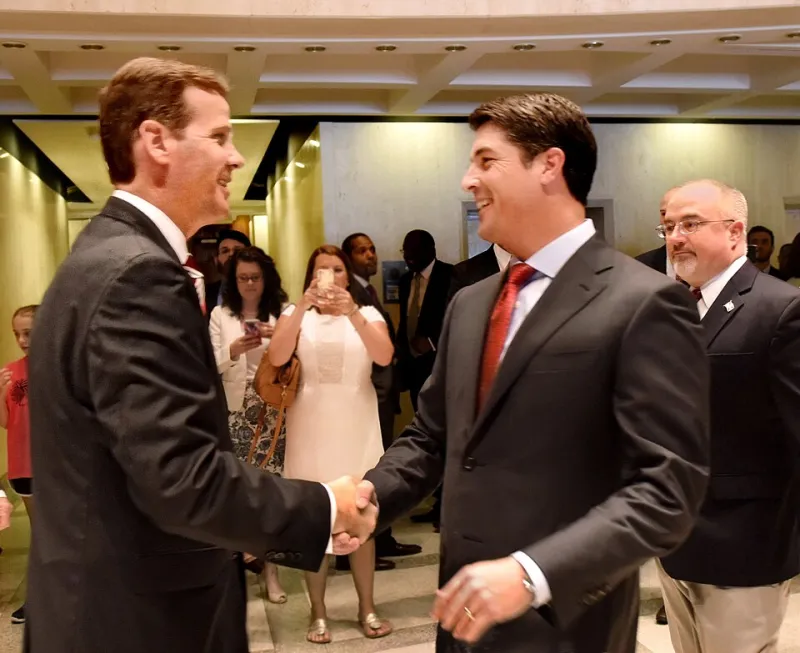
Photo: Florida House of Representatives, Public domain, via Wikimedia Commons
There was a time, not so long ago, when a handshake over a café table in Manchester carried real weight. Two businesspeople, a mutual understanding, a job done. That era has not merely faded — the conditions that sustained it have been dismantled. Today's business is conducted across video calls, messaging apps and shared drives, often between parties who have never met in person. When something goes wrong, there is no shared recollection to fall back on. There is only evidence, or the absence of it.
The Myth of the Simple Arrangement
Sole traders and micro-businesses frequently resist formal documentation on cost grounds, and the instinct is understandable. Legal fees feel disproportionate when the deal is worth a few thousand pounds. But the arithmetic changes the moment a dispute arises. What begins as a disagreement over scope of work or payment terms can escalate into a claim that consumes months of management time, thousands of pounds in fees, and — for small operations — the goodwill of customers caught in the crossfire.
The courts do not refuse to hear disputes just because the arrangement was informal. Quite the opposite: a significant body of UK case law demonstrates how easily unwritten arrangements unravel. Disputes over whether terms were agreed at all, what was said in a phone call, or whether a course of dealing implied particular terms are notoriously fact-sensitive. Judges must reconstruct intentions from fragmentary emails and contested recollections. That reconstruction rarely favours either party cleanly — which is precisely why these cases settle late, expensively, and often bitterly.
Why the Risks Have Grown, Not Shrunk
Several shifts have converged to make informality more dangerous than it once was.
Dispersed dealings. Remote and hybrid working mean conversations happen in writing across multiple platforms. A term agreed in a WhatsApp message, another in an email, a third verbally on a call — the resulting patchwork is fertile ground for disagreement.
Accessible dispute routes. Online portals, small claims track procedures and money claim services have lowered the barrier to litigation. Where once a disgruntled counterparty might have grumbled and moved on, formal claims are now initiated with a few clicks.
Leaner balance sheets. Smaller enterprises carry less margin for error. A single unpaid invoice or unfulfilled commitment can cascade into cashflow difficulties that larger businesses simply absorb.
Third-party scrutiny. Lenders, insurers and acquirers increasingly expect documented terms. An informal trading relationship that seemed harmless can complicate financing or an eventual sale.
A Minimum-Paperwork Checklist
Formality need not mean expense. The following baseline can be adopted by almost any small operation, much of it without professional input.
-
Put the core terms in writing before work begins. A short agreement or even a well-drafted email confirming scope, price, payment terms, timelines and what happens if either side wants out. Ask the other party to reply confirming — that reply creates a record.
-
Confirm verbal agreements the same day. If a call produces a change to the deal, follow it with a brief email: "Just to confirm what we agreed…" This single habit prevents a remarkable proportion of disputes.
-
Keep a single channel of record. Consolidate key decisions into email. Messaging apps are convenient but scattered; designate one place where the contractual narrative lives.
-
Use standard terms for repeat business. A set of terms and conditions, referenced on invoices and websites, creates consistency across customers. Review them annually.
-
Document changes to scope. Variations are where informal arrangements most often fracture. A one-line written confirmation of any change — and its price — is disproportionately valuable.
-
Get professional help where it counts. Standard documents can be self-served, but shareholder arrangements, significant supply contracts and anything involving personal guarantees warrant a solicitor's eye. The fee is trivial against the exposure.
-
Retain records beyond completion. Keep contracts and correspondence for at least six years — the limitation period for most contract claims in England and Wales.
Trust and Paperwork Are Not Rivals
The objection most often raised is cultural: formal documents signal distrust. In our experience the opposite is true. A clear written agreement tells a counterparty that you take the relationship seriously, that expectations are explicit, and that neither side is relying on memory. It removes ambiguity precisely where ambiguity does damage.
The handshake was never really the foundation of good business — shared understanding was. Writing that understanding down simply preserves it when memories diverge. For small businesses operating on thin margins and thinner time, that preservation is not bureaucracy. It is insurance, and it costs considerably less than the alternative.